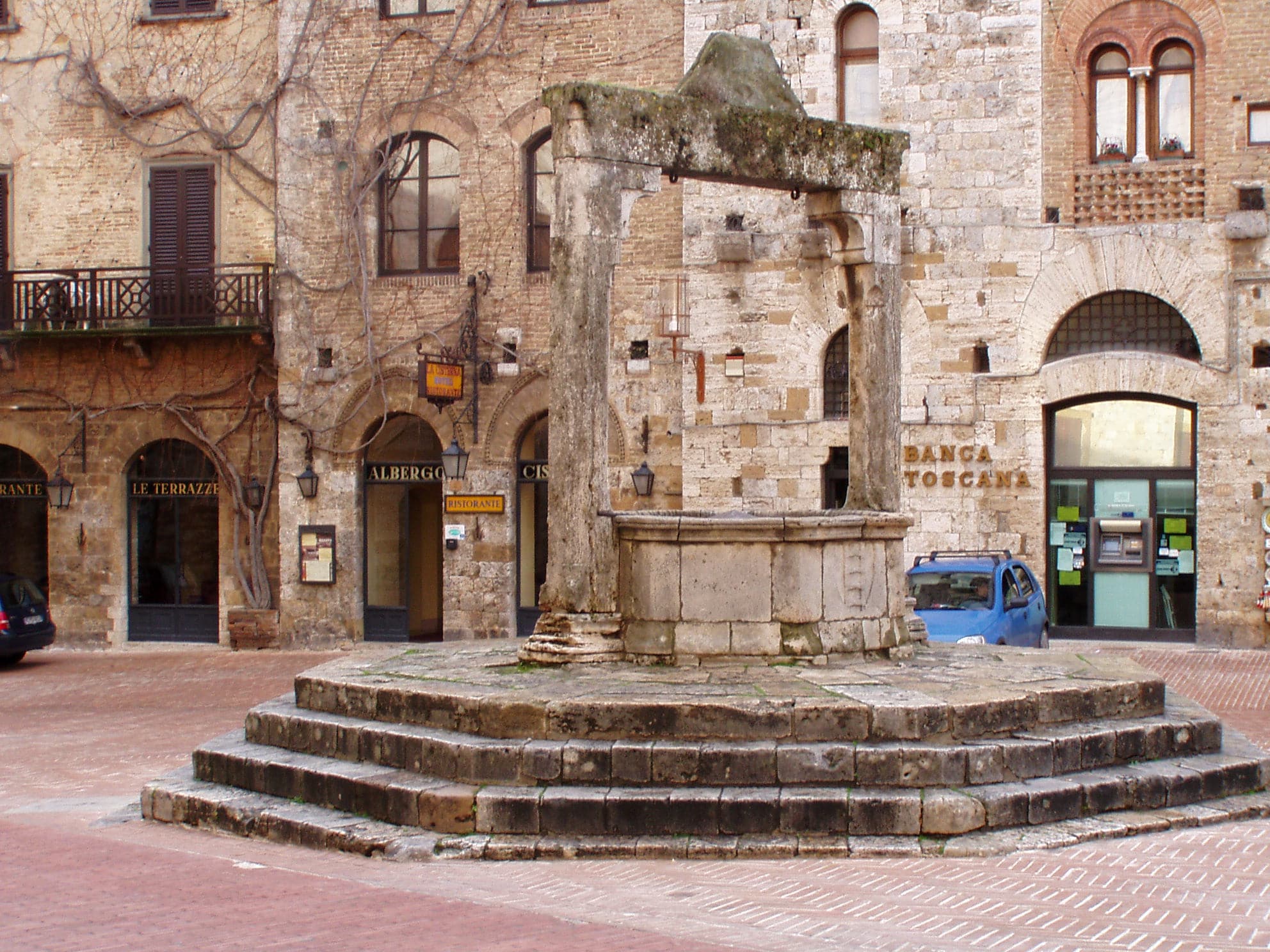


Places to visit in San Gimignano

Originally constructed in the 12th century, Giuliano da Maiano expanded the Santa Maria Assunta Romanesque church in 1457 by adding a transept and side chapels. There are several remarkable fresco cycles inside the church. A 15th-century fresco by Benozzo Gozzoli and two wooden figures by Iácopo della Quercia depicting the Annunciation date to the same period on the entrance wall. A large 14th-century cycle by Barna da Siena featuring three bands of New Testament scenes is located in the right aisle.

One of the best places in San Gimignano, the Palazzo del Pópolo is located to the left of Santa Maria Assunta. The Municipal Art Gallery is also inside it. The museum’s collections include a 13th-century painted crucifix by Coppo di Marcovaldo, Lippo Memmi's Madonna Enthroned, two round Annunciation paintings by Filippino Lippi, and an altarpiece painted by Pinturicchio in 1511. You can visit the Torre Grossa and admire the views of the town and surrounding area.

Built-in a basic Gothic style between 1280 and 1298, the church of Sant'Agostino is an aisleless brick structure. It is located close to Porta San Matteo at the northern point of the old town. The magnificent cycle of Benozzo Gozzoli's 15th-century frescoes in the choir. They portray the life of St. Augustine in 19 scenes, from his early years in North Africa to his vision of St. Jerome and his passing. For art enthusiasts, this chapel ranks among the must-see tourist places in San Gimignano

San Gimignano 1300 is an exposition and museum of history. Its main attraction is a sizable scale model of the city as it was in 1300. It is composed of baked clay that was taken from neighbouring caverns and painted with natural dyes. Additional miniature scenes depict elements of the city's architecture and reenact moments of medieval street life. All the structures and the people are made by hand using clay, making it one of the most interesting places to visit in San Gimignano.

It's intriguing to observe what life was like in the 1700s, long after the town's loss in prominence but still centuries before its restoration and UNESCO praise. An affluent Florentine family renovated the much older tower house complex into the 18th-century palazzo, which was a residence for the upper middle class. It still has the original furniture and family heirlooms. This is among the best places to visit in San Gimignano as it also houses one of the town's famous medieval towers.

Take a stroll through the historic centre of San Gimignano. It is surrounded by walls dating back to the 13th century. You can witness magnificent vistas from here. Additionally, there are some ancient town gates, which were constructed by the Medici. Built-in the 13th century, the earlier Porta San Giovanni features a guardroom supported by an unusual segmented arch. The 12th-century Porta San Matteo and the atmospheric Medieval-era Porta delle Fonti at the east end lead to a mediaeval public fountain.

The Rocca, or fortress, was constructed in 1353 by the Florentines against the town walls and was destroyed in 1555 by Cosimo I's order. It is located on the top of the hill and is counted among the most beautiful places to visit in San Gimignano. There are amazing views of the town and surrounding countryside from the top of the tower. It is the last remaining portion of the walls. The Ferie delle Messi, a medieval event, includes the annual La Giostra dei Bastoni tournament.

The Museo Storico della Tortura has a collection of real historical items, and wax figures graphically illustrate how effective the torture methods were. One section shows the techniques that were frequently employed by the Inquisition Tribunal to drive the devil out of people who were accused of witchcraft. The associated Museo della Pena di Morte examines capital punishment and its modes of implementation. Although the history of the death sentence is somewhat more prominent here, there is still plenty of graphic, deadly technology.

The Archeological Museum and the Santa Fina Herbarium are housed in the Conservatorio di Santa Chiara. One of the most unique places to visit in San Gimignano, it houses over a hundred ceramic and glass artefacts from the Spedale di Santa Fina's Herbarium. These are displayed in a replica pharmacy, complete with the kitchen used to prepare herbal cures. The Archaeological Museum features exhibits from the Etruscan, Roman, and Medieval periods. You can see temporary art exhibits in the Modern and Contemporary Art Gallery.
FAQ's
What are the best places to visit in San Gimignano?
The best places to visit in San Gimignano include the stunning Torre Grossa for panoramic views, the Civic Museum for its rich art collection, and the Collegiate Church with its beautiful frescoes. Also, make sure to visit the charming Piazza della Cisterna and the historic San Gimignano 1300 Museum.
Why is Santa Maria Assunta famous?
Santa Maria Assunta is famous for its stunning frescoes by renowned artists such as Lippo Memmi and Benozzo Gozzoli. The church is a masterpiece of Romanesque architecture and serves as a significant religious and cultural landmark in San Gimignano.
What is the best time to visit Casa Campatelli and Tower?
The best time to visit Casa Campatelli and its Tower is early morning or late afternoon to avoid large crowds. Additionally, visiting during weekdays can also enhance your experience with fewer visitors.
How to reach San Gimignano?
To get to San Gimignano from Florence, take a direct bus or a combination of train and bus. It takes around 2 hours to reach by a direct bus from Florence's Santa Maria Novella station to San Gimignano. Additionally, you can take a train to Poggibonsi and then a bus to San Gimignano.
Why Santa Chiara Museum is so famous?
The Santa Chiara Museum is among the best tourist places in San Gimignano and is famous for its impressive collection of religious art artefacts. It showcases frescoes, sculptures, and sacred objects from the Middle Ages and Renaissance.